
Carbon removal cannot rely on technology alone: fairness matters to public support
New international research involving the Bennett Institute finds that public consultation, expert scrutiny and fair sharing of benefits can significantly increase support for carbon removal technologies, with people unwilling to trade fairness for greater technical performance.
As countries look for ways to reach net zero, removing carbon dioxide from the atmosphere is expected to become an increasingly important part of global climate action. But new research suggests that technological effectiveness alone will not determine whether carbon removal projects gain public support.
A major international study involving Professor Benjamin Sovacool finds that people place considerable importance on how carbon removal projects are governed, who gets a say in decisions and who benefits from them.
Published in Nature Climate Change, the study, “Public support for novel carbon removal hinges on procedural and distributive fairness”, surveyed 10,852 people across Brazil, Malaysia, Saudi Arabia, Italy, Norway and the UK. The research investigated attitudes towards three emerging carbon dioxide removal (CDR) approaches: direct air carbon capture and storage (DACCS), bioenergy with carbon capture and storage (BECCS), and enhanced rock weathering (ERW).
Participants considered different versions of potential carbon removal projects, varying who implemented them, how decisions were made, how profits were distributed and how much carbon dioxide the projects could remove. This enabled the researchers to look beyond general attitudes towards particular technologies and investigate what kinds of implementation people considered acceptable.
Fair processes matter
The results reveal a strikingly consistent message across countries and technologies: fairness matters.
Of the project characteristics examined, procedural fairness had the strongest effect on support. Compared with projects where decisions were taken without consultation, involving either local communities or scientific experts increased public support by around one to 1.7 points on a ten-point scale.
How the financial benefits of projects were distributed was also important. Projects that shared revenues with affected local communities or operated on a not-for-profit basis generally attracted more support than projects in which profits were retained privately. By contrast, whether a project was implemented by a company or regional government had relatively little influence on attitudes.
Crucially, greater technological performance did not erase these concerns. While people generally preferred projects capable of removing larger amounts of CO₂, the researchers found that high carbon-removal capacity could not compensate for a lack of consultation or the private retention of profits.
This suggests that policymakers and developers cannot assume the climate benefits of carbon removal will themselves be sufficient to secure public legitimacy.
From public acceptance to public involvement
The findings also indicate that many people want communities to have a meaningful role rather than simply being informed about decisions after they have been made.
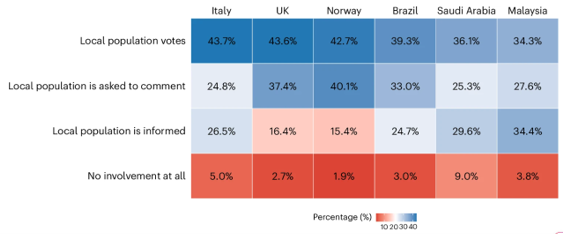
This was particularly apparent in the European countries surveyed. When asked about permitting new carbon removal projects, around 44% of respondents in the UK and Italy and 43% in Norway considered giving the local population a vote to be the fairest approach. Only a small minority across the six countries considered no community involvement at all to be the fairest option.
The results are particularly significant because many carbon removal technologies remain relatively unfamiliar to the public and their governance frameworks are still emerging. The authors argue that this creates an important window of opportunity to establish principles for responsible implementation before technologies, business models and institutional arrangements become entrenched.
Implications for climate policy
Carbon removal is not a substitute for rapid emissions reductions, but it is increasingly expected to complement deep decarbonisation as countries pursue their climate goals. Scaling these technologies could have significant consequences for land, infrastructure, investment and communities, creating questions not only about technical performance but also about who carries the risks, who receives the benefits and who participates in decisions.
The study therefore has a clear message for policymakers: governance and public engagement should be designed alongside carbon removal technologies, rather than treated as issues to address once deployment has begun.
The researchers identify four lessons for the development of carbon removal policy: open decision-making to public and expert scrutiny; consider models that distribute benefits more widely; recognise that technological effectiveness cannot simply compensate for unfair governance; and develop forms of public engagement early enough to shape strategies and deployment, rather than relying solely on consultation around individual projects.
The authors also highlight a potential tension between the urgency of scaling carbon removal and the time and space required for meaningful public participation. They suggest policymakers could explore engagement at regional and system level, involving communities earlier in discussions about where and how carbon removal should form part of wider climate strategies.
Ultimately, the research shows that the challenge of carbon removal is not solely technological. If CDR is to expand at the scale envisaged in future climate strategies, questions of trust, participation, fairness and public benefit will need to sit at the heart of its governance.
Read the research paper:
Public support for novel carbon removal hinges on procedural and distributive fairness
Watch the seminar: with Michela Boldrini, Bocconi University & Francesco Granella, CMCC; Watch the seminar recording