
Keeping Cities Cool: A New Blueprint for Climate-Resilient Urban Futures
As the UK faces increasingly frequent heatwaves, new Bennett Institute research offers a practical framework for helping cities stay cool, protect vulnerable communities and accelerate the transition to a low-carbon future.
As climate change drives more frequent and intense heatwaves, cities around the world face a growing challenge: how can they keep people safe and comfortable without increasing energy demand and carbon emissions?
New research ‘Cool cities, local contexts: A typology of cooling interventions across the disciplines to address extreme heat and decarbonization in urban areas‘ by Melissa A. Martin and Professor Sovacool, develops a new typology of cooling interventions, providing policymakers, city leaders and planners with a comprehensive framework for responding to extreme heat in ways that are equitable, effective and sustainable.
The challenge is urgent. Rising temperatures, urbanisation and the urban heat island effect are increasing demand for cooling worldwide. Air conditioning can save lives and improve wellbeing, but it also places growing pressure on electricity systems and can contribute to greenhouse gas emissions if deployed without wider planning.
The research argues that cities need to move beyond seeing air conditioning as the only solution. Instead, they should adopt a whole-systems approach that combines climate adaptation, decarbonisation, public health and social equity.
Four pathways to cooler cities.
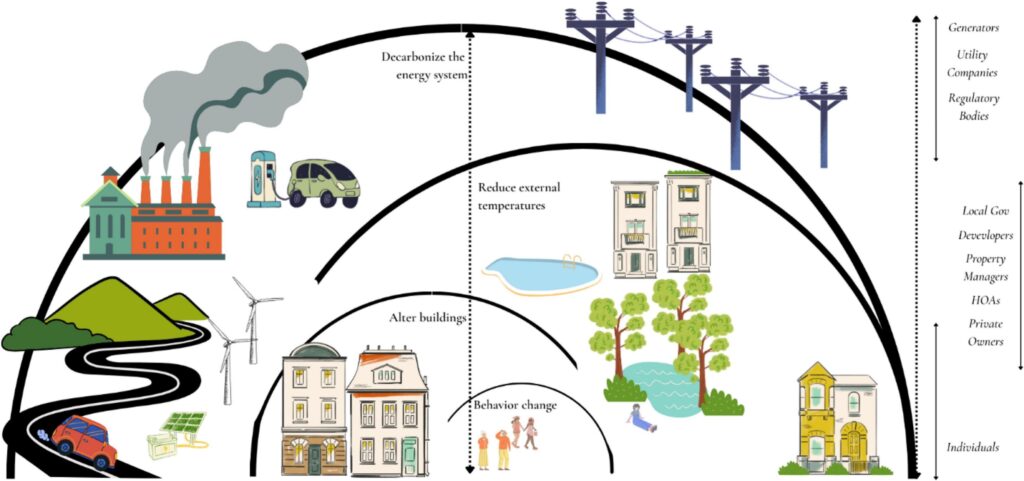
Drawing on evidence from more than 900 studies and case examples, the researchers identify four complementary categories of intervention:
- Lower external temperatures. Nature-based and urban design solutions can reduce heat before it reaches buildings and people. These include: Urban trees and green infrastructure; Green roofs and walls; Water-based cooling features; Reflective surfaces and “cool roofs”. These interventions not only reduce temperatures but can also improve biodiversity, public spaces, health and wellbeing.
- Alter buildings. Buildings themselves are a critical part of the solution. Better insulation, shading, ventilation and passive cooling design can significantly reduce indoor temperatures and energy demand. Efficient active cooling technologies can then be used where needed.
- Change behaviour. Simple behavioural changes can make a meaningful difference. Adjusting thermostat settings, pre-cooling buildings, improving energy management and adopting heat-smart behaviours can reduce pressure on energy systems while maintaining comfort and health.
- Decarbonise energy and material systems. Long-term resilience requires cleaner energy systems. Renewable electricity, grid modernisation, energy storage and low-carbon building materials can break the feedback loop between rising temperatures and rising emissions.
Innovation at the intersection of climate, health and equity.
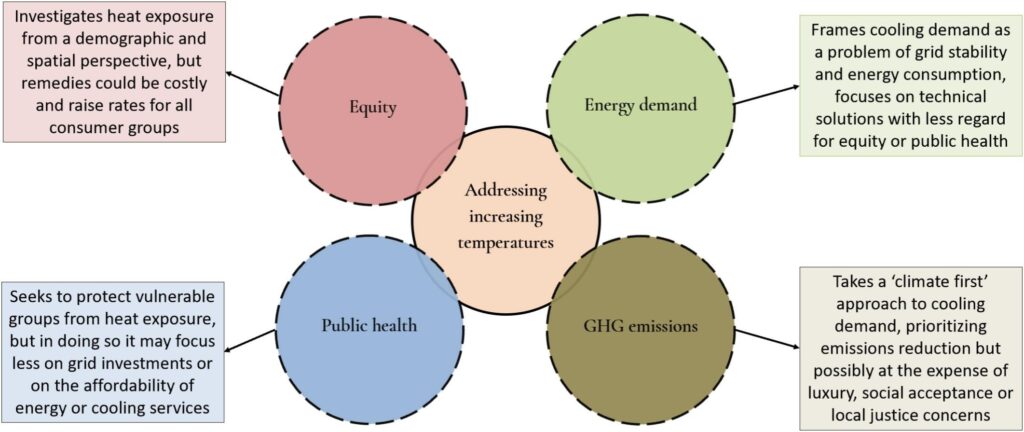
A central finding of the research is that extreme heat is not simply an environmental issue. It is also a challenge for public health, energy security and social justice. Vulnerable communities often experience higher temperatures, have lower-quality housing and face greater barriers to accessing cooling.
The authors show that there is no universal solution. Effective policy depends on local context, priorities and place-based evidence. Cities seeking to reduce energy demand may prioritise building retrofits and behaviour change, while those focused on public health may invest more heavily in cooling infrastructure and resilient buildings. Areas seeking to address inequality may target greening and retrofit programmes towards disadvantaged communities.
Why this matters now: lessons for the UK heatwave
The research arrives at a critical moment for the UK. In recent summers, heatwaves that were once considered rare have become increasingly common, placing growing pressure on public health services, infrastructure, energy systems and the built environment. The UK’s housing stock, much of which was designed to retain heat rather than shed it, is particularly vulnerable to overheating as temperatures rise.
The study highlights that responding to extreme heat requires more than emergency measures during a heatwave. Instead, cities and communities need a coordinated, long-term strategy that addresses the root causes of urban overheating while protecting vulnerable residents.
Many of the solutions identified in the research have direct relevance to UK policymakers and local authorities. Urban greening can help cool neighbourhoods while improving public spaces. Retrofitting homes with better insulation, shading and ventilation can improve comfort year-round while reducing energy bills. Public information campaigns can help households adapt safely to high temperatures, while investment in low-carbon energy systems ensures that growing cooling demand does not undermine net zero goals.
The research also underscores an important equity challenge. Heat exposure is not experienced equally. Older people, young children, people with existing health conditions, outdoor workers and those living in poorly insulated housing often face the highest risks during extreme weather events. As the UK adapts to a warmer climate, ensuring that cooling and resilience measures reach the most vulnerable communities will be essential.
For the Bennett Institute, this is precisely the kind of challenge that demands policy acceleration: bringing together evidence across disciplines, identifying practical solutions, and supporting decision makers to act before crises become emergencies. The study provides a roadmap for how cities can move from reactive responses to proactive resilience – helping create healthier, fairer and more climate-resilient communities in the UK and beyond.