New international proposal sets out roadmap for moving beyond GDP
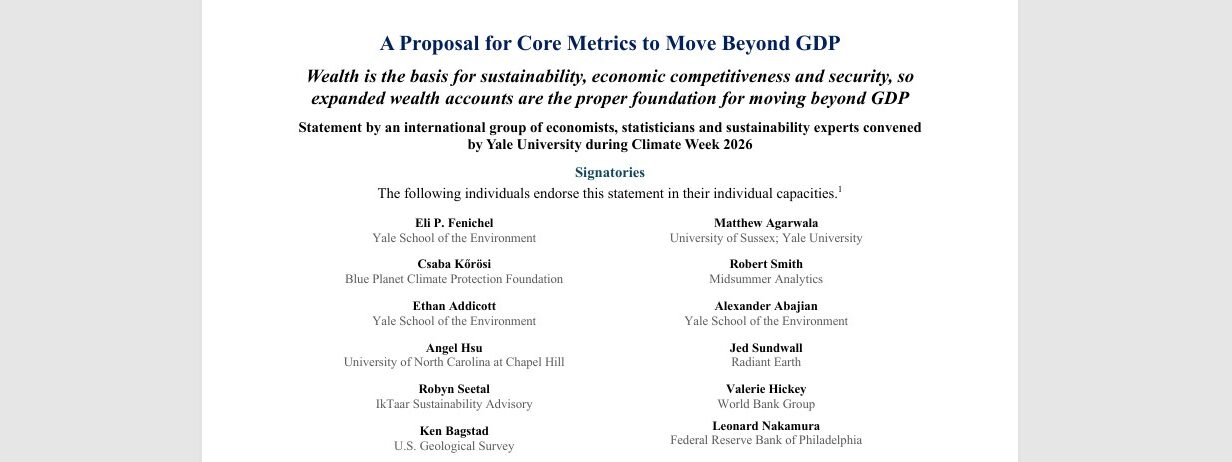
Wealth is the basis for sustainability, economic competitiveness and security, so expanded wealth accounts are the proper foundation for moving beyond GDP. Statement by an international group of economists, statisticians and sustainability experts.
A new international proposal co-authored by Professor Matthew Agarwala and Yale University calls for a fundamental rethink of how nations measure economic progress, arguing that traditional measures such as GDP fail to capture whether today’s prosperity is being built sustainably for future generations.
Published following discussions convened by Yale University during NYC Climate Week 2026, the statement brings together leading economists, statisticians and sustainability experts to propose a new framework centred on measuring the wealth that underpins economies, rather than focusing solely on what they produce.
Signatories including Professor Eli Fenichel (Yale School of the Environment), and experts from organisations including the World Bank Group, U.S. Geological Survey, and the Federal Reserve Bank of Philadelphia argue that GDP alone cannot reveal whether economic growth is coming at the expense of natural resources, environmental stability or future wellbeing. Instead, they call for a broader approach based on national wealth accounts that track a country’s stocks of natural, human, social, produced and financial capital.
Under the framework, investments in nature, education, public health and social cohesion would be recognised as essential contributors to long-term prosperity, rather than treated simply as short-term costs. The approach would also make it easier for governments, businesses and the public to understand whether development is sustainable over time.
Prof. Matthew Agarwala said:
“GDP remains an important measure of economic activity, but it tells us little about whether we’re building the assets that support future prosperity. Wealth accounting provides a practical and scientifically grounded way of understanding whether countries are preserving and growing the natural, human and social foundations on which long-term wellbeing depends.”
A central feature of the proposal is a four-step roadmap for accelerating the global adoption of wealth accounting.
- Build international agreement. Bring together experts through the UN process to establish a common set of concepts and methods for measuring national wealth, forming part of the UN’s Framework for Inclusive and Sustainable Well-being due in 2028.
- Establish a Global Wealth Institute. Create an independent, time-limited organisation responsible for compiling comprehensive wealth accounts for countries around the world while national capacity is being developed.
- Publish annual wealth accounts. Produce open-access reports, data, tools and technical guidance that track changes in national wealth and help policymakers, businesses, researchers and the public understand whether development is sustainable.
- Support countries to adopt wealth accounting. Provide training and capacity-building for statisticians, policymakers and decision-makers so countries can ultimately produce and use their own wealth accounts to guide economic and environmental policy.
The proposal builds on a growing body of work on measuring wealth, sustainability and long-term prosperity. Together, these initiatives seek to ensure that measures of economic success reflect the full range of assets that support wellbeing and economic resilience over time. The proposal argues that the question is no longer whether the world needs to move beyond GDP, but how quickly it can do so. The authors are urging governments and international institutions to begin building the systems, partnerships and expertise needed to measure the wealth that underpins long-term wellbeing and economic resilience.
The authors acknowledge that while the proposal does not measure every dimension of well-being, it rests on accounting structures that are conceptually and analytically clear, and the indicators it yields are highly relevant to assessing progress. A wealth accounting approach offers the best option for nations to move beyond GDP.